C2 Children’s Home Planning Across England
Rahul Taheem Ltd provides specialist planning advice and application support for small Class C2 children’s homes across England.
We assist care providers, operators, investors, developers and property owners with planning feasibility, route assessment, C3 dwellinghouse to C2 children’s home changes of use, Lawful Development Certificate applications, full planning applications, planning statements, appeals and application management.
Every proposal turns on its own facts. The most appropriate planning route may be a Lawful Development Certificate, a full planning application or, in some cases, advice not to proceed. We do not treat every property or operational model as suitable, and no planning outcome can be guaranteed.
Selected C2 Children’s Home Planning Approvals: A Snapshot only
Rahul Taheem Ltd has secured Class C2 children’s home approvals across England through both full planning and Lawful Development Certificate routes.
The examples below provide a snapshot of 17 approvals across 14 Local Planning Authorities. They include homes accommodating two, three and four children, differing staffing and management arrangements, and proposals involving both dwellinghouses and houses in multiple occupation.
The examples cover a range of planning circumstances, including parking, highways, residential amenity and, where relevant, local planning policy considerations.
C2 Lawful Development Certificate Approvals
London Borough of Barking and Dagenham
Application reference: 26/00732/CLUP
Lawful Development Certificate granted for the proposed use of a dwellinghouse as a Class C2 children’s care home for up to three children aged 9 to 17.
The approved operational model included a live in carer, an overnight carer, two daytime carers working on a shift rotation basis and manager attendance.
London Borough of Barking and Dagenham
Application reference: 25/01787/CLUP
Lawful Development Certificate granted for the proposed use of a dwellinghouse as a Class C2 children’s care home for up to two children aged 8 to 17, supported by up to two carers working on a shift rotation basis alongside a manager.
Tendring District Council
Application reference: 25/00920/LUPROP
Lawful Development Certificate granted for the proposed use of a Class C3 dwellinghouse as a Class C2 children’s care home for up to three children, with two carers working on a shift pattern and a manager attending during normal business hours.
London Borough of Newham
Application reference: 25/02752/CLP
Lawful Development Certificate granted for the proposed use of a dwellinghouse as a Class C2 children’s care home.
The Council accepted that the defined operation would not represent a material change of use requiring planning permission.
C2 Full Planning Permissions
Epping Forest District Council
Application reference: EPF/2021/25
Full planning permission granted in Chigwell for the change of use of a Class C3 dwellinghouse to a Class C2 children’s care home for up to two children.
London Borough of Waltham Forest
Application reference: 261253
Full planning permission granted in Leyton for the change of use of a dwellinghouse to a Class C2 children’s care home for up to two children aged 7 to 17.
Chesterfield Borough Council
Application reference: CHE/24/00620/FUL
Full planning permission granted for the change of use of a dwellinghouse to a Class C2 children’s care home, together with new windows serving first floor bedrooms.
Norwich City Council
Application reference: 26/00024/U
Full planning permission granted for the change of use of a dwellinghouse in Norwich to a Class C2 children’s care home.
London Borough of Brent
Application reference: 25/1897
Full planning permission granted in Wembley for the change of use of an existing house in multiple occupation to a children’s home.
London Borough of Hillingdon
Application reference: 79986/APP/2026/732
Full planning permission granted in Uxbridge for the change of use of a Class C3 dwellinghouse to a Class C2 children’s home for two children.
Royal Borough of Greenwich
Application reference: 25/3284/F
Full planning permission granted in Abbey Wood for the change of use of a Class C3 dwellinghouse to a Class C2 children’s care home for up to two children, together with associated cycle parking and waste storage.
Derby City Council
Application reference: 24/01667/FUL
Full planning permission granted in Derby for the change of use of a Class C3 dwellinghouse to a Class C2 children’s care home for a maximum of two children.
London Borough of Havering
Application reference: P1089.24
Full planning permission granted in Romford for the change of use of a Class C3 dwellinghouse to a Class C2 children’s home for up to two children.
East Lindsey District Council
Application reference: 02387/25/FUL
Full planning permission granted in North Thoresby for the change of use of an existing dwellinghouse to a children’s home.
Royal Borough of Greenwich
Application reference: 25/2306/F
Full planning permission granted in Plumstead for the change of use of a Class C3 dwellinghouse to a Class C2 children’s care home for up to two children aged 8 to 16, together with associated cycle storage.
London Borough of Newham
Application reference: 23/02532/COU
Full planning permission granted in Stratford for the change of use of ground and first floor residential accommodation from Class C3 to Class C2 to provide two children’s assisted living units.
Nuneaton and Bedworth Borough Council
Application reference: 041302
Full planning permission granted in Nuneaton for the change of use of a Class C3 dwellinghouse to a Class C2 children’s care home for two children.
C2 Experience Across Different Planning Routes
These approvals demonstrate experience across the two principal planning routes commonly considered for small Class C2 children’s homes.
A full planning application requires assessment of the planning merits. This can include the principle of development, the need for the proposed home, the loss of family housing, residential character, neighbouring amenity, staffing, vehicle movements, parking, highways, waste and cycle storage, and the overall planning balance.
A proposed use Lawful Development Certificate application involves a different assessment. The central question is whether the precisely defined operational model would create a material change in the character of the existing use as a dwellinghouse.
The number of children, staffing arrangements, shift patterns, handovers, manager attendance, professional visitors, vehicle movements, shared facilities and the overall character, intensity and rhythm of occupation can all be important.
Rahul Taheem Ltd assesses the property, planning history, proposed operational model and Local Planning Authority approach before advising on the planning route that appears most appropriate.
The approvals above provide a snapshot of our wider Class C2 children’s home planning experience across England. Every proposal turns on its own facts and no previous planning permission or Lawful Development Certificate guarantees the outcome of another application.
Choosing the Correct C2 Planning Route
The starting point is not simply completing an application form. It is understanding the lawful existing use, planning history, site context, property arrangement and the proposed operational model.
We consider the proposed number of children, daytime and overnight staffing, shift changes, handovers, manager attendance, professional and family visits, vehicle movements, parking, access, facilities, layout and the likely character and intensity of the proposed use.
The correct planning route may be a Lawful Development Certificate, a full planning application or advice not to proceed.

Lawful Development Certificate C2 Applications
A proposed use Lawful Development Certificate is a fact and degree assessment. The central question is whether the proposed operation would result in a material change from the existing lawful use of the property.
It is not a planning policy balancing exercise. The Council must assess the true character of the proposed use on the actual evidence, including the number of children, staffing presence, shift changes, handovers, visitors, vehicle movements, facilities, layout, intensity, rhythm and residential character of the operation.
General dislike, public perception and objections to children’s homes are not themselves the legal test. However, the proposed operational model must be clearly defined, internally consistent and supported by appropriate evidence.
Every case turns on its own facts and a Lawful Development Certificate cannot be assumed merely because another Council has granted one elsewhere.
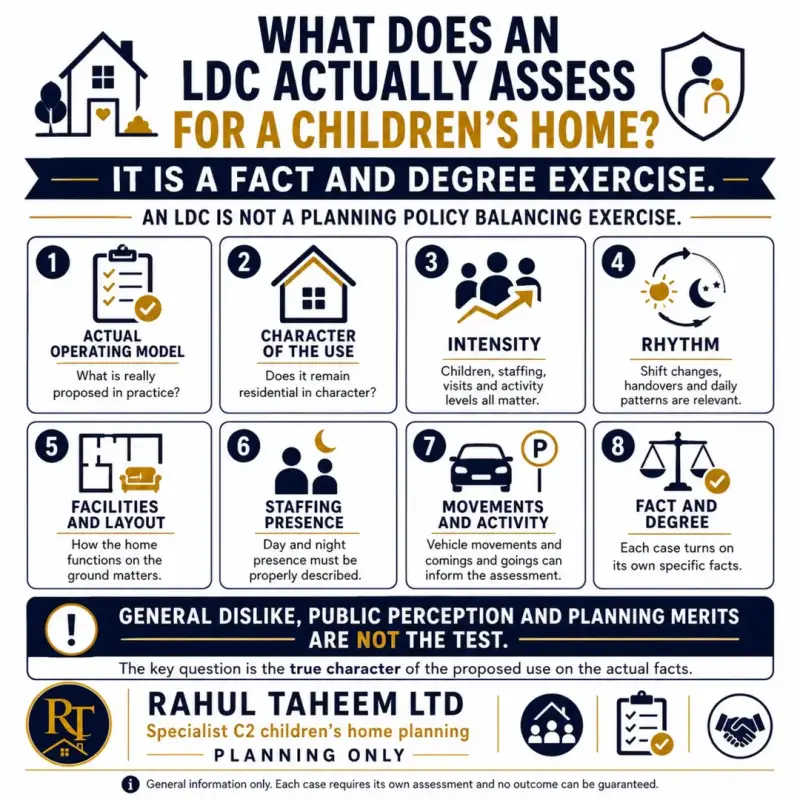
Lawful Development Certificate assessment for a C2 children’s home covering operating model, character, intensity, rhythm, layout, staffing and movements
Full Planning Applications for C2 Children’s Homes
Where the proposed use is likely to amount to a material change of use, or where the facts and local planning position require it, a full planning application may be the appropriate route.
The Council may consider the loss of a family dwelling, the identified need for suitable children’s homes, community and social inclusivity benefits, residential amenity, parking, access, highway impacts, local planning policy and the overall planning balance.
A strong application should address both the benefits of providing a safe, stable and supportive home for children and any genuine site specific planning impacts. The proposal must be assessed on its individual facts, and neither planning need nor previous approvals elsewhere guarantee permission.
Every application requires a clear operational description, suitable plans and proportionate supporting evidence addressing the issues relevant to the particular property and local authority area.
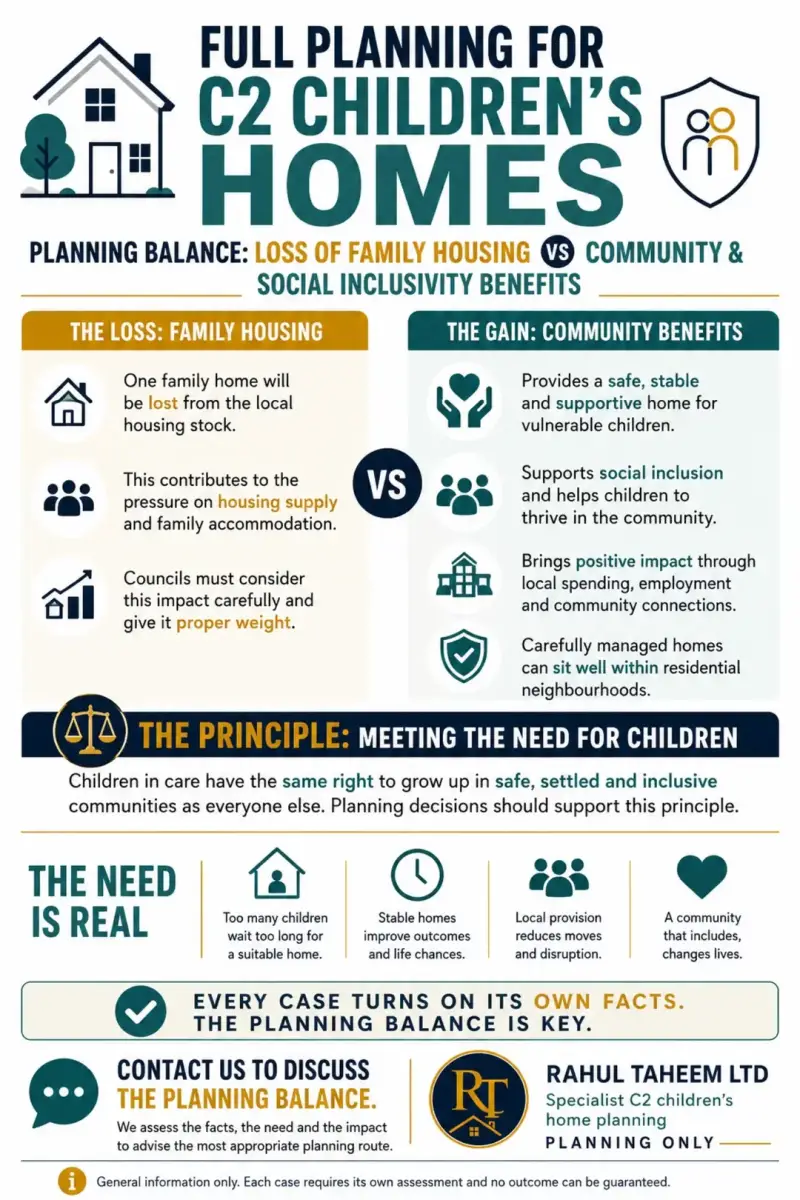
Full planning application for a C2 children’s home considering family housing, community benefits, social inclusion and the planning balance
Selected C2 Children’s Home Planning Approvals
The examples below show selected Lawful Development Certificates and full planning permissions secured or supported by Rahul Taheem Ltd across different local authority areas in England.
Each decision was based on its own property, planning history, operational model, staffing arrangements and supporting evidence. Previous approvals demonstrate relevant experience but do not guarantee the outcome of any future application.
Doncaster Full Planning Permission
City of Doncaster Council granted full planning permission for the change of use of a C3 dwellinghouse to a Class C2 children’s care home

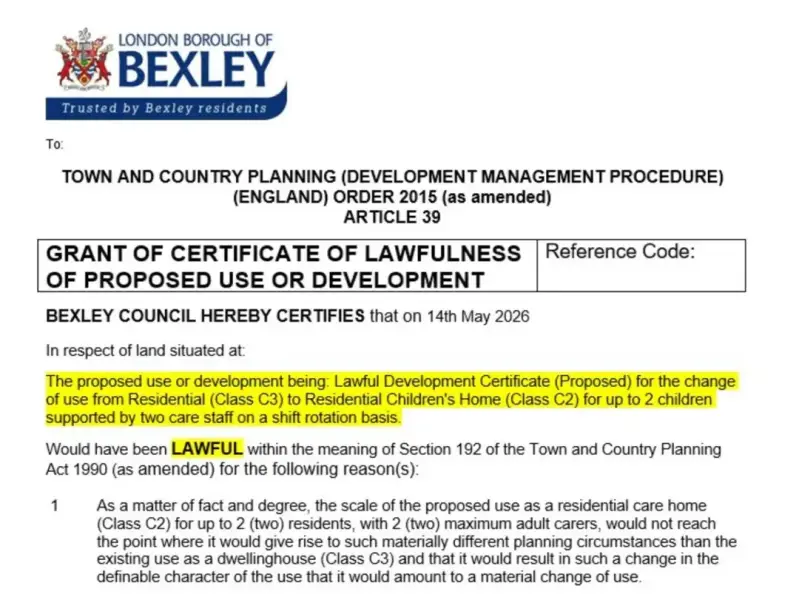
Bexley Lawful Development Certificate
The London Borough of Bexley granted a proposed use Lawful Development Certificate for a Class C2 children’s home for up to two children supported by two care staff under a defined shift model.
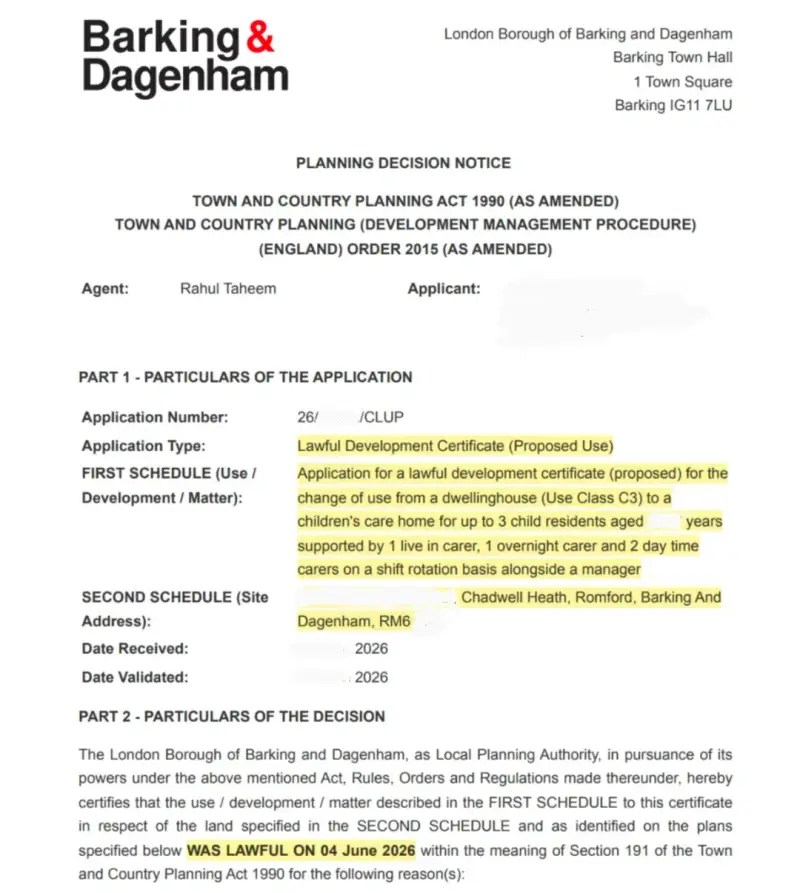
Barking and Dagenham Lawful Development Certificate
The London Borough of Barking and Dagenham granted a proposed use Lawful Development Certificate for a Class C2 children’s home for up to three children under a defined staffing and management model.
Basingstoke Full Planning Permission
Basingstoke and Deane Borough Council granted full planning permission for the change of use of a dwellinghouse to a Class C2 children’s care home.
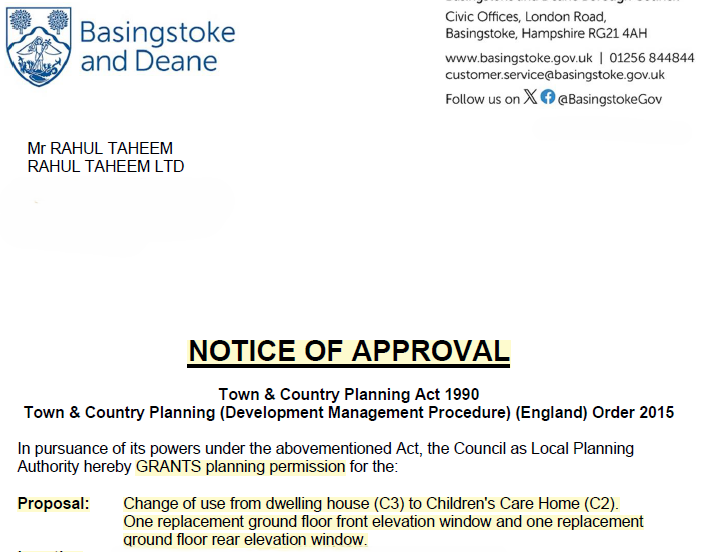
Personal and site specific information has been removed where appropriate. These extracts are drawn from public planning decision records. Council names and logos are reproduced solely as part of those records and do not imply endorsement of Rahul Taheem Ltd. Each decision turned on its own facts and does not guarantee the outcome of any future application.
Rahul Taheem Ltd. Registered in England and Wales. Company number 12238895. Registered office: 39 Wakemans Hill Avenue, London, NW9 0TA
Create Your Own Website With Webador